
Chase blames software bug for nationwide outage that slowed payments across major U.S. banks
JPMorgan said transactions were back to normal Monday evening and ruled out a cyberattack, but the disruption rippled through Zelle and rival banks, the third big U.S. tech failure in three business days.

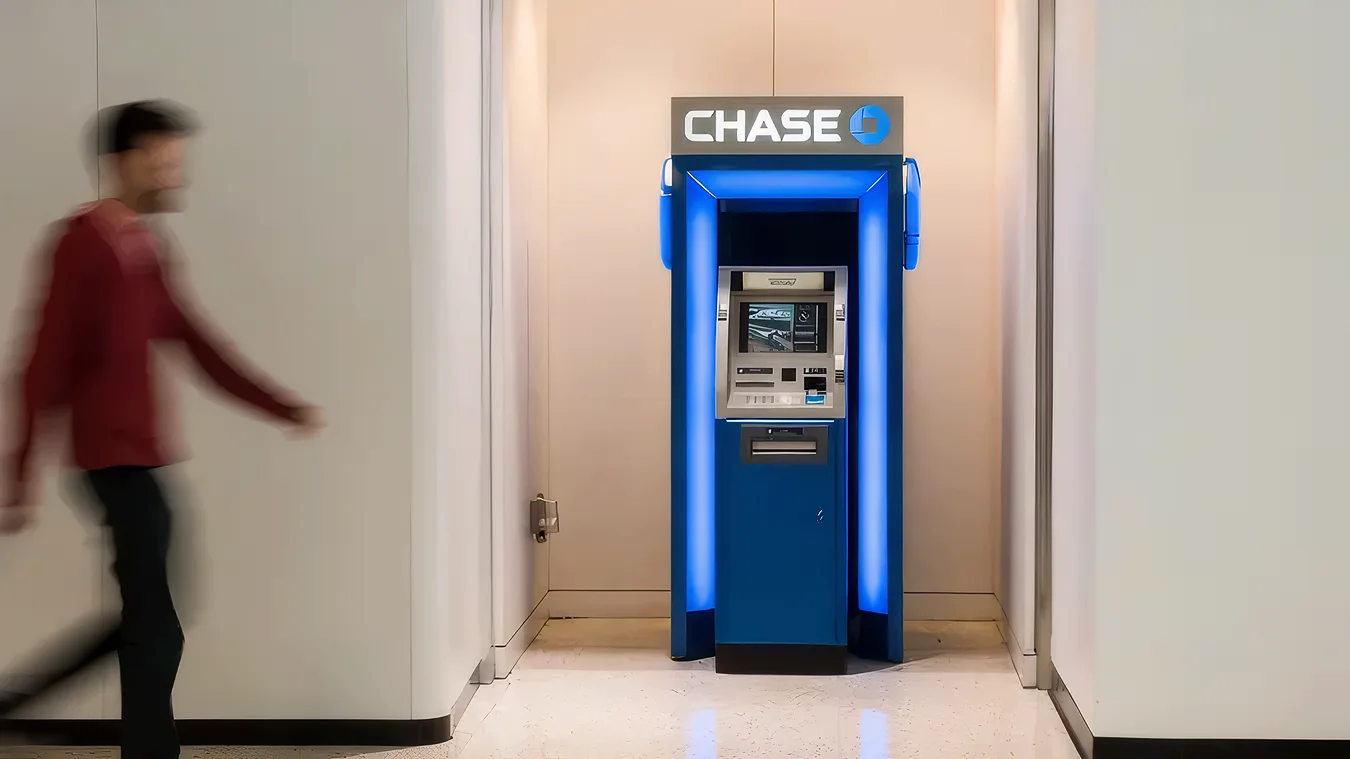
A Chase ATM
JPMorgan Chase said Monday evening that transactions were processing normally again after a software bug disrupted its systems for much of the day, an outage that slowed payments for customers of the nation's largest bank and, in turn, for people trying to send money to them from other lenders and through Zelle. 6abc reported that the bank's transactions were back to normal by Monday night. The bank said the failure was a bug in its own systems and not a cyberattack, and Yahoo Finance reported that customers kept access to their accounts and funds throughout.
The trouble began Monday morning, according to a source familiar with the matter cited by NBC News, and complaints built through the early afternoon. More than 4,400 Chase customers had reported problems to the outage tracker Downdetector by 1:35 p.m. ET, NBC 5 Dallas-Fort Worth reported, and Forbes said reports peaked near 5,000 around 2 p.m. Some Chase customers saw an in-app message saying certain services were unavailable, the Associated Press reported, and a teller at a Chase branch in Washington told Fox Business that in-branch and online problems started around 10 a.m. and cleared a little after 3 p.m. Downdetector counts come from user submissions, Yahoo Finance noted, so they do not by themselves prove an outage at a bank.
You might be interested in
Chase described the cause as a software bug in on-premise hardware systems, saying in a post on X at about 4 p.m. ET that it was working to fix it, NBC News reported. Spokesman Joe Evangelisti said the problem was not systemic and that other banks were affected only when they were a party to a transaction with Chase, according to the Associated Press. Fox Business, citing an FBI official, reported that the disruption was traced to a software release the bank had rolled out earlier Monday that hit a subset of its systems, with no sign of malicious or outside cyber activity. A person familiar with the matter told NBC News that regulators were in touch with the affected banks right away and quickly concluded the problem was contained. As of early Tuesday, ABC7 Chicago noted, the bank had not given further detail on the cause.
The spillover ran mostly through shared payment links. Zelle, which is run by Early Warning Services and owned by a group of large banks including Bank of America, Capital One, JPMorgan, PNC, Truist, U.S. Bank and Wells Fargo, was not itself down, the company said, though Zelle transfers involving Chase accounts were delayed for customers of other institutions, the Associated Press reported. A U.S. Bank spokesman said its own systems were not directly affected, Yahoo Finance reported, while Bank of America said its systems had run normally all day, according to CBS News. Even so, Downdetector logged spikes in complaints about several of them, including more than 1,300 for Bank of America and about 650 for U.S. Bank by early afternoon, NBC 5 reported.
Chase counts about 94 million customer relationships in the United States, along with roughly 5,000 branches and 15,000 ATMs, NBC News reported, and it was not clear how many accounts were affected. Bank stocks slid on Monday: shares of JPMorgan, Bank of America, Citigroup and Wells Fargo each fell about 2 percent and the Nasdaq KBW Bank Index lost 1.6 percent, Yahoo Finance reported, with JPMorgan closing down 2.3 percent at $338.21, according to the Free Press Journal. The move is hard to pin on the outage alone. Bloomberg reported that the S&P 500 fell 1.9 percent on the day, its third straight loss, as chip stocks tumbled ahead of Nvidia's earnings report.
The outage was the third major U.S. technology failure in three business days, CNN noted. Microsoft's Outlook, Teams and Copilot went down on Thursday for more than a day, as our earlier report detailed, and on Friday a four-hour nationwide ground stop led to a weekend of flight delays and cancellations, 6abc reported. The Associated Press said that disruption was caused by a router that malfunctioned and overwhelmed the aging air traffic control system. On Monday evening United Airlines reported its own system problem that briefly delayed some departures, which 6abc said was unrelated and quickly resolved. Government officials and company leaders have said the three disruptions were not connected, according to the Associated Press.
What happens next is largely a question of scrutiny. Vitaly Ford, a computer science professor at Arcadia University, told 6abc that banks share much of the same payment plumbing, so a fault at one can look like everyone has a problem, and that testing a fix across a national system is far harder than testing it in a lab. Federal rules require banks to notify their primary regulator as soon as possible, and no later than 36 hours after determining that a significant computer-security incident has occurred, according to the Federal Reserve's Community Banking Connections publication. It was not clear from public statements Monday night whether the Chase failure met that threshold, and the bank had yet to publish a fuller account of what went wrong.