
Dow jumps 1,100 points and S&P 500 posts best day since April as oil slides ahead of inflation report
A plunge in crude and a chip-stock rebound recovered much of last week's AI-driven rout, but Tuesday's October CPI now tests whether a December Fed rate hike stays on the table.

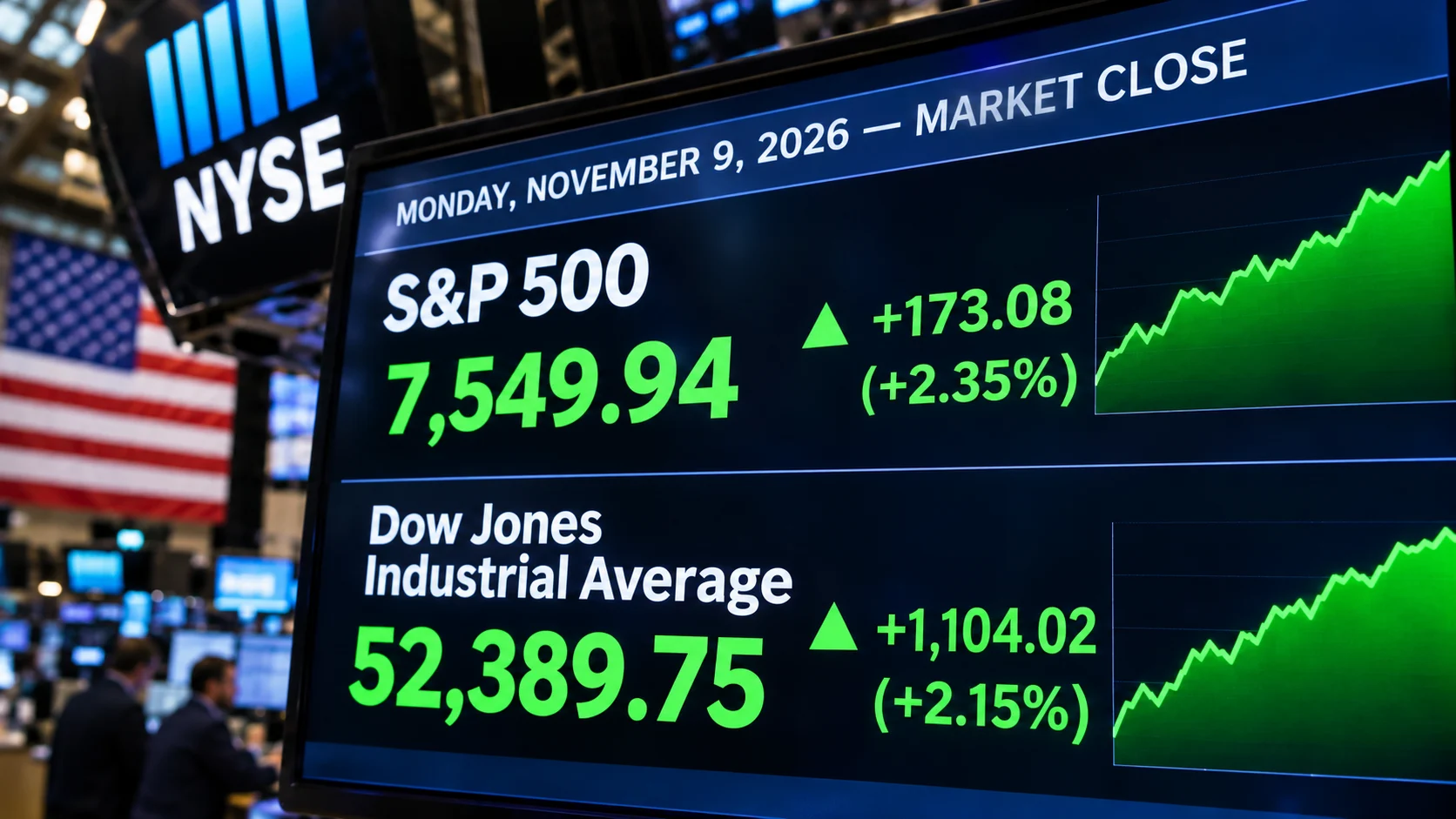
a close-up of an NYSE screen, ticker showing the S&P 500 or Dow in green
Wall Street staged its sharpest rally in seven months on Monday as a steep drop in oil prices and a bounce in chip stocks erased much of the damage from last week's artificial intelligence sell-off, setting up a high-stakes inflation report on Tuesday morning. The Dow Jones Industrial Average gained 1,104.02 points, or 2.15 percent, to close at 52,389.75, Reuters reported. The S&P 500 rose 2.35 percent to 7,549.94, its best day since April 8, and the Nasdaq Composite climbed 2.74 percent to 25,253.14.
Crude was the main catalyst. Brent futures fell 5.85 percent to settle at $92.57 a barrel, while U.S. West Texas Intermediate dropped to $86.85, after President Donald Trump told CNN he thought it highly unlikely he would order fresh attacks on Iran as long as talks to end the war progress. The Associated Press noted that Brent has now come down from more than $112 at the start of the month, easing worries that energy costs would keep feeding inflation. The relief was not guaranteed to last: both Washington and Tehran reported shipping hit in or near the Strait of Hormuz, and Secretary of State Marco Rubio said Sunday that some Iranian demands had been unreasonable.
You might be interested in

The rebound followed one of the worst stretches for stocks in more than a year. On Thursday, the Dow fell 1,833 points, or 3.4 percent, the S&P 500 dropped about 4.3 percent, and the Nasdaq sank 5.5 percent into correction territory, its worst day since April 2025, ABC News reported. That slide came a day after a post-midterm rally, as investors weighed whether Democratic control of Congress could slow the build-out of AI data centers. Nvidia lost about 9 percent that day, and CNBC reported that the so-called Magnificent 7 collectively lost $1 trillion in market value.
Chip stocks led Monday's recovery. Reuters said an index of semiconductor shares surged 6.9 percent after plunging more than 12 percent the week before, and the S&P 500 rebounded from its biggest weekly drop since April 2025. Nvidia was the notable exception, falling about 4 percent to its lowest close since April 7 as investors questioned CEO Jensen Huang's future following an internal investigation tied to a possible foreign intelligence effort aimed at him. CNBC said the Dow is now back above where it closed on Election Day, while the S&P 500 and Nasdaq remain slightly below.
The calm is likely to be tested quickly. The Bureau of Labor Statistics releases the October Consumer Price Index at 8:30 a.m. ET Tuesday, and economists surveyed by Bloomberg expect a 0.3 percent monthly increase in headline prices and 0.2 percent in the core measure, NBC News reported. That would be a clear slowdown from September's 0.6 percent jump, which pushed annual inflation to 3.7 percent. No annual figure will be published for October because last year's government shutdown prevented the collection of price data, a gap that puts extra weight on the month-to-month change.
The data matters because it is the last inflation reading before the Federal Reserve meets on December 8-9. The central bank raised its benchmark rate by a quarter point in September and held it at 3.75 percent to 4 percent in October, according to CNBC, and a much stronger-than-expected October jobs report on Friday, with employers adding 165,000 positions, lifted expectations of another increase. Market odds of a December hike stood at about 85 percent on Monday afternoon, NBC News reported, and the 10-year Treasury yield has hovered near 4.9 percent.
Strategists say a soft CPI reading may not be enough to change that path. Economists cited by CNBC said that, short of an unmistakably weak print, the numbers are unlikely to dissuade the Fed from hiking in December, and Fed officials have warned that price pressures first driven by tariffs and the Iran war are spreading to other parts of the economy. A hotter-than-expected report would likely add to rate-hike bets and could pressure the stocks that rallied Monday, particularly the rate-sensitive technology shares that have swung hardest in recent days.