
Total solar eclipse crosses mainland Europe for the first time in 27 years
The Moon's shadow swept from the Arctic across Greenland and Iceland before reaching northern Spain at sunset, drawing crowds along its narrow path.

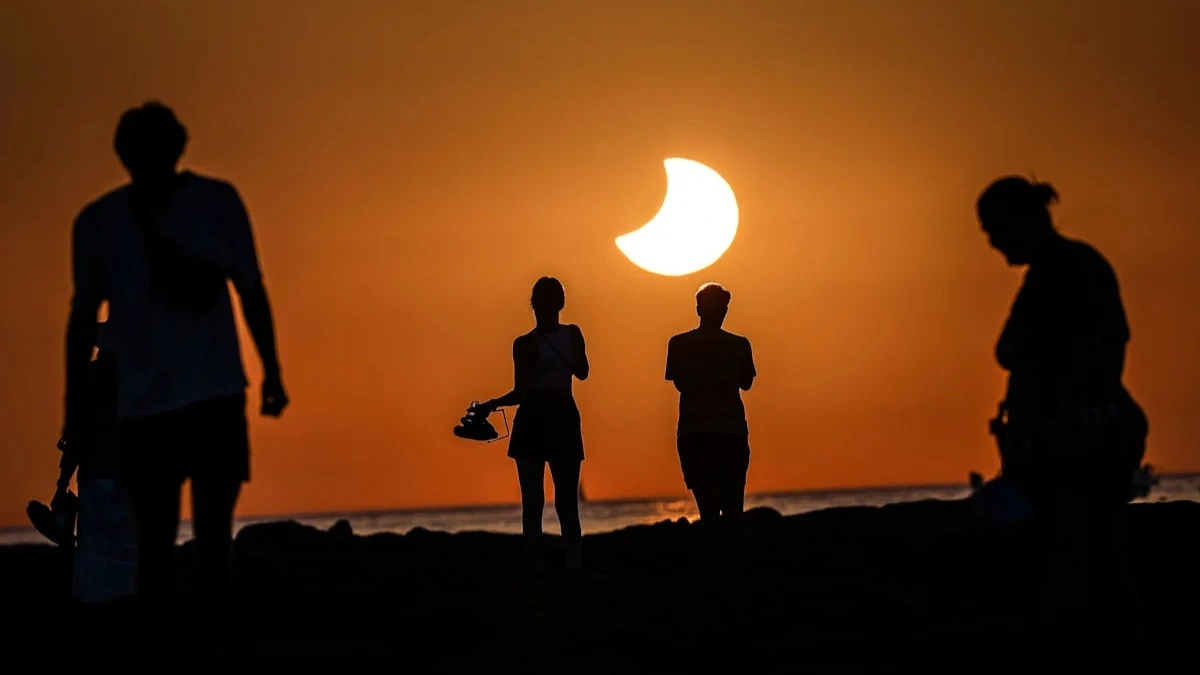
A total solar eclipse swept across the Northern Hemisphere on Wednesday, tracing an unusual path that carried it from the remote Siberian Arctic over Greenland and Iceland before reaching northern Spain and a small corner of Portugal just before sunset, marking the first time totality has crossed mainland Europe in 27 years.
The eclipse's path was shaped by an uncommon geometry, beginning at sunrise over Russia's largely uninhabited Taymyr Peninsula and arcing up and over the Arctic before curving south, rather than following the more typical west-to-east track most eclipses take. That path gave Iceland its first total eclipse since 1954, while Spain had not seen one since 1905.
You might be interested in


Totality lasted longest, just over two minutes, along the eclipse's centerline over the Atlantic Ocean near Iceland's coast, where crowds gathered on the country's western Snaefellsnes peninsula despite the risk of cloud cover common to the region in August. Farther along the path, viewers in northern Spain experienced a shorter period of darkness as the eclipse reached them in the day's final hour before sunset.
Officials in both Iceland and Spain reported a significant influx of visitors traveling specifically to view the event from within the roughly 100-mile-wide band where the Moon fully blocked the Sun, with hotels along the path reporting monthslong bookings in advance. Outside that narrow band, a partial eclipse was visible across much of Europe, parts of northwestern Africa, and even the northern edge of the United States and Canada.
The event coincided with the peak of the annual Perseid meteor shower, giving some observers in darker viewing locations the rare chance to catch meteors streaking past during the brief window of daytime darkness.
Astronomers noted the next total solar eclipse to cross Spain will follow in under a year, while Iceland is not expected to see another until the next century, giving this year's event particular significance for skywatchers in both countries.