
NASA launches Nancy Grace Roman Space Telescope on mission to probe dark energy
The observatory lifted off from Kennedy Space Center on a Falcon Heavy rocket and now begins a months-long journey to its final orbit.

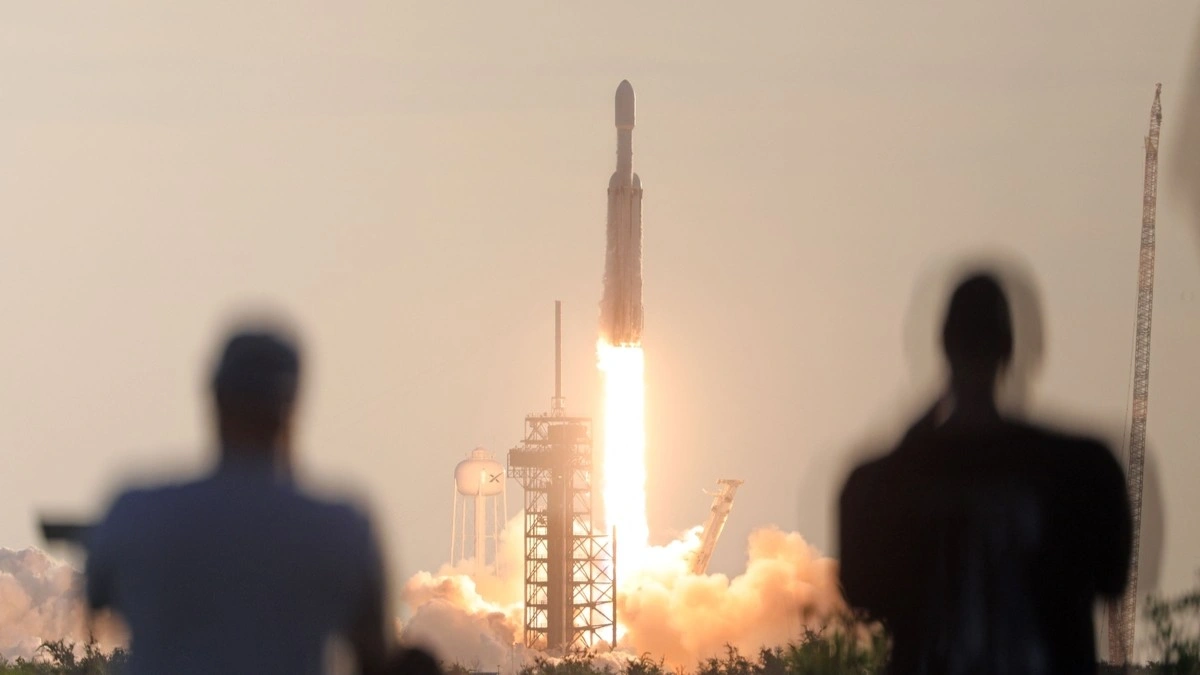
The Roman Space Telescope lifts off atop a Falcon Heavy rocket | NASA
NASA's Nancy Grace Roman Space Telescope lifted off successfully from Kennedy Space Center on Sunday morning, riding a SpaceX Falcon Heavy rocket into orbit at the start of a mission designed to probe two of the biggest open questions in astrophysics: the nature of dark matter and dark energy.
The launch took place from Launch Complex 39A shortly after sunrise, and mission teams confirmed the spacecraft separated cleanly and began communicating with ground controllers as expected. Roman now begins a journey of roughly three months and about a million miles to its planned operating position, a gravitationally stable point beyond the Moon's orbit where it will remain in constant sunlight.
You might be interested in


Named for the astronomer often credited as the mother of the Hubble Space Telescope, Roman is built around a wide-field instrument that will let it survey areas of sky roughly a hundred times larger than Hubble can capture in a single image, while still gathering the sharp, detailed views associated with space-based observatories.
Scientists plan to use that wide view to map the large-scale structure of the universe, tracking how galaxies are distributed and how that distribution has changed over cosmic time, data that researchers hope will sharpen our understanding of dark energy, the mysterious force thought to be accelerating the universe's expansion.
The telescope is also expected to be a powerful tool for finding exoplanets, using a technique that watches for the way a distant planet's gravity briefly magnifies the light of a star passing behind it. NASA has said Roman's data will be made public quickly after collection, through a cloud-based archive designed to let researchers around the world begin working with the observations soon after they come down from the spacecraft.
If the post-launch checkout goes as planned, mission managers expect Roman to begin its science operations within roughly a year, joining a small fleet of major space observatories that includes Hubble and the James Webb Space Telescope.