
Norway's King Harald V dies at 89; son becomes King Haakon VIII
Harald reigned for more than 35 years and became known for a relatively informal style of monarchy. His son succeeded him automatically under Norway's constitution.

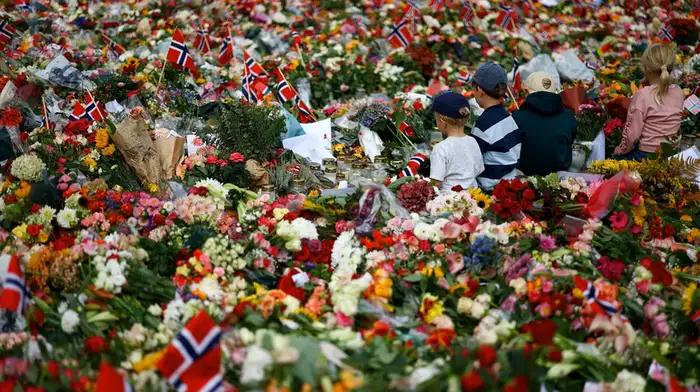
Flowers and Norwegian flags laid outside the Royal Palace in Oslo
King Harald V of Norway, Europe's oldest reigning monarch, died Friday at the age of 89, the Royal Court announced, ending a reign of just over 35 years and prompting an immediate, automatic transfer of the crown to his son.
The palace said Harald died peacefully at Oslo University Hospital's Rikshospitalet at 6:35 a.m. local time. He had been hospitalized since August 17 after developing a bacterial infection in his bloodstream, a complication that followed several years of recurring health problems, including a pacemaker fitted to manage an irregular heartbeat.
You might be interested in


Crown Prince Haakon, 53, became king immediately upon his father's death under Norway's constitution, and is expected to take the regnal name Haakon VIII once it is formally confirmed at an extraordinary Council of State. His eldest child, Crown Princess Ingrid Alexandra, 22, becomes heir apparent, a position she holds under a 1990 constitutional amendment that made the eldest child, regardless of gender, first in line to the throne.
Norwegian Prime Minister Jonas Gahr Støre led tributes to the late king, saying the country was in mourning and expressing gratitude for what he called a long life dedicated to the nation's service. Crowds gathered outside the Royal Palace in Oslo in the days before Harald's death to lay flowers as his condition worsened.
Harald ascended to the throne in January 1991 following the death of his father, King Olav V, and went on to build a reputation for a relatively informal and approachable style of monarchy, along with a consistent public emphasis on tolerance and national unity. As a child, he had spent part of World War II in exile in the United States after Nazi Germany occupied Norway.
Like other constitutional monarchies in Europe, Norway's royal family holds a largely ceremonial role, with governing power resting with an elected parliament representing the country's roughly 5.5 million people. Harald was widely credited with helping modernize the monarchy's public image while resisting the trend, seen in some other European royal houses, of abdicating in old age.